


Nautical History · Newport · 7 min read
The 12-Metre Era: The America’s Cup Years That Defined Newport
From Kennedy watching the races off Newport to the boats still sailing Narragansett Bay today, the 12-Metre era left a mark on Newport that never really went away.
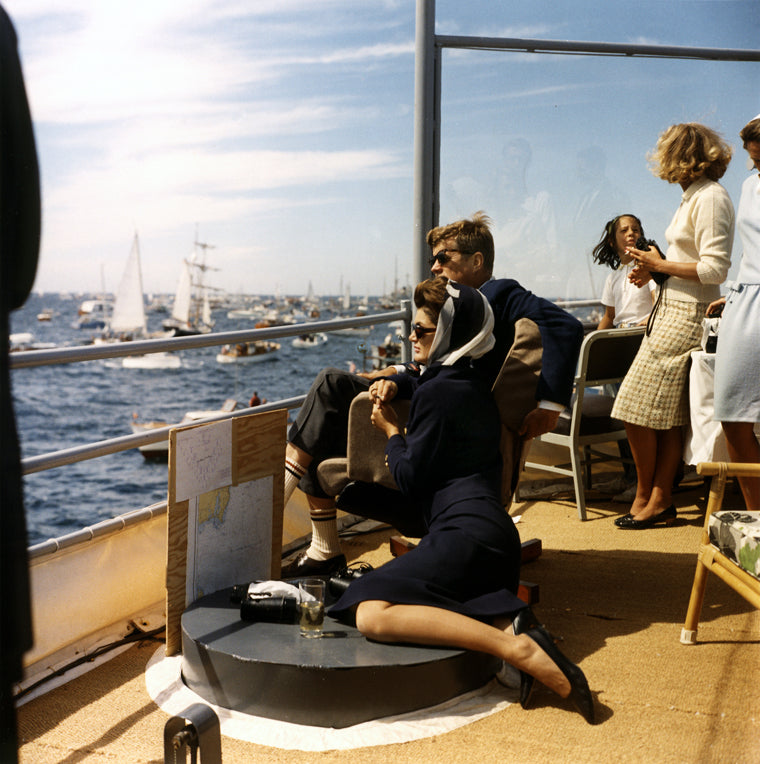
President and Mrs. Kennedy watch the America’s Cup off Newport, September 15, 1962, aboard USS Joseph P. Kennedy Jr. Robert Knudsen, White House Photographs, John F. Kennedy Presidential Library and Museum. Public domain.
There was a time when the America’s Cup was Newport.
From 1930 until 1983, the America’s Cup was raced off Newport. For the last 25 of those years, it was raced in 12-Metres.
The Newport story didn’t start with 12-Metres. It started with the J-Class. Harold Vanderbilt defended the Cup here three times: with Enterprise in 1930, Rainbow in 1934 and Ranger in 1937. Then came the war.
When the Cup returned in 1958 after 21 years away, it came back in a different kind of boat. The giant J-Class yachts were gone, too expensive for a post-war world. In their place: the 12-Metre.
The boats changed. The crews changed. Designers kept finding new ways to make them faster. The challengers came from Britain and Australia, while France, Sweden, Canada and Italy also entered the increasingly competitive challenger field.
But the backdrop stayed remarkably consistent: Newport, Narragansett Bay, the New York Yacht Club and the Atlantic just beyond the harbor.
For Newport, the 12-Metre era became more than a racing series. It became part of the town.
What exactly was a 12-Metre?
The name is slightly misleading. A 12-Metre was not a 12-meter-long boat. The class was governed by an International Rule rating formula that balanced dimensions and performance rather than simply limiting overall length.
That left designers room to search for an advantage in hull shape, sail plan, weight, balance and countless smaller details. The boats looked traditional enough to belong in Newport, but they were racing machines at the edge of contemporary yacht design.
Twenty-five years.
One harbor.
The Newport 12-Metre Era
Why Newport?
Newport wasn’t chosen simply because it was a beautiful place to sail. It was chosen because the New York Yacht Club needed a better place to race the America’s Cup — and Newport already had the sailing culture and infrastructure to support it.
By 1930, New York Harbor had become increasingly congested with commercial traffic, making it a difficult place for Cup racing. Newport was already the New York Yacht Club’s summer sailing headquarters, and the club proposed moving the Cup there. Newport offered protected waters and fair winds in Narragansett Bay, while the open Atlantic was close at hand for ocean racing.
It was also more than a good piece of water. Newport and the surrounding Rhode Island waterfront had the sailors, yacht clubs, boatyards, designers and maritime trades needed to support serious racing. Nearby Bristol was home to Herreshoff, one of the most important yacht-building yards in American sailing history.
And once the Cup arrived, Newport became the home of the American defense. From 1958 through 1983, the New York Yacht Club’s defenders included Columbia, Weatherly, Constellation, Intrepid, Courageous, Freedom and Liberty. These weren’t simply boats that happened to race in Newport. They were part of a larger sailing community that lived, worked and raced here.
For more than half a century, Newport wasn’t just the place where the America’s Cup was held.
It was where the American defense lived.

And this is where the history gets a little more personal.
The boat closest to us is Weatherly, US-17 — the same yacht that defended the America’s Cup for the New York Yacht Club in 1962. Courageous, US-26, later defended successfully in 1974 and 1977.
These aren’t just names in an old race record. They are boats you can still see on Narragansett Bay.
Beautiful boats. Serious racing.
It is easy to look back at the 12-Metre era and see beautiful old yachts. But these were not museum pieces. They were racing machines.
America’s Cup designers used tank testing and increasingly sophisticated methods to refine hull shapes, construction, rigging and sail plans. By the later years of the era, computers and new materials were becoming part of the search for speed.
The result was a fascinating combination: traditional sailing and increasingly modern thinking.

From a distance, the boats can look almost impossibly simple: hull, mast, sail and sea.
Up close, every part of the picture changes. The sails load. The hull accelerates. Lines come tight. The crew moves. The boat heels.
The history becomes physical.
The boats became characters.
One of the things that makes the Newport years so memorable is that people remember the boats by name.
Columbia. Weatherly. Constellation. Intrepid. Courageous. Freedom. Liberty.
Each had a campaign behind it — owners, designers, sailors, builders and crews. Some returned to defend. Others disappeared from the Cup after a single campaign.
And some became part of Newport’s permanent sailing landscape.

Sailing Weatherly
More recently, we had the chance to race aboard Weatherly during the New York Yacht Club Annual Regatta.
There is something different about seeing a historic boat from the dock and sailing aboard her.
The deck moves beneath you. The sails load up. The lines are under tension. The crew shifts weight. The boat heels.
Suddenly the names in an old America’s Cup record stop feeling like names in a history book.
Weatherly is a boat.
A real one. And she is still sailing.

1983: The Cup leaves Newport.
By 1983, the 12-Metre era had reached its final Newport chapter.
The defender was Liberty, skippered by Dennis Conner. The challenger was Australia II, skippered by John Bertrand.
Australia II had something nobody could quite see. Its unconventional winged keel had been closely guarded, and it became the signature technical story of the campaign.
Liberty led 3–1. Australia II won the next three races, taking the Cup from the New York Yacht Club for the first time in 132 years.
And with that, the America’s Cup left Newport.
The boats stayed.
But the boats stayed.
When the Cup moved on, Newport did not stop being a sailing town. The 12-Metre fleet remained active, and the boats continued to race on the same waters that had made them famous.
Then, in 2023, the 12 Metre World Championship returned to Newport. Ten historic 12 Metres raced on Narragansett Bay and Rhode Island Sound, including four boats that had successfully defended the America’s Cup here during the 1958–1983 era: Columbia, Weatherly, Courageous and Freedom.
Newport remembers.
The America’s Cup moved on. The boats didn’t.
That may be why the 12-Metre era still feels so present in Newport. You can walk the waterfront and see the same sort of boats that once carried the America’s Cup. You can recognize the names. You can go sailing and find yourself beside a piece of American sailing history.
And when the classic yachts come out onto Narragansett Bay, the past doesn’t feel particularly far away.

Newport is a place where sailing isn’t simply something people watch.
It’s something people do.
President Kennedy understood that. The night before he watched Weatherly race off Newport, he told the America’s Cup crews:
“We have salt in our blood, in our sweat, in our tears. We are tied to the ocean. And when we go back to the sea, whether it is to sail or to watch it, we are going back from whence we came.”
America’s Cup official history and venue history; International Twelve Metre Association / 12 Metre Worlds official history and 2023 World Championship coverage. President Kennedy’s remarks to the America’s Cup crews, September 14, 1962, John F. Kennedy Presidential Library. The Kennedy photograph is a U.S. federal government work and is in the public domain.
Born by the sea. Built by hand.
The original marine-grade rope bracelet, handcrafted in Newport for salt, sun and sea.
More from the Journal
Nautical History · Seamanship · 3 min read
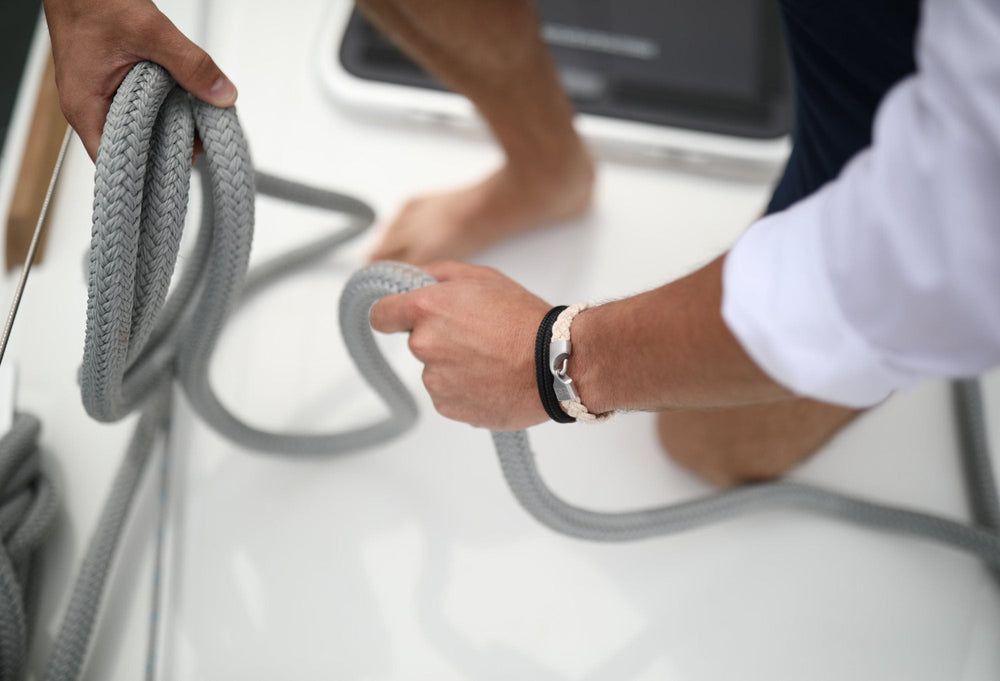
Why Do Sailors Wear Rope Bracelets?
There’s a fair amount of rope on a boat. Some of it eventually finds its way onto a wrist. Tradition, a connection to the water, or simply a good-looking piece of kit?...
READ THE STORY →
Materials · Nautical History · 3 min read
The Turks Head: A Nautical Classic, Reimagined
The traditional Turks Head had to be cut off. Here’s how we rethought a New England summer classic with a 316L stainless steel clasp, a refined braid and a better fit.
READ THE STORY →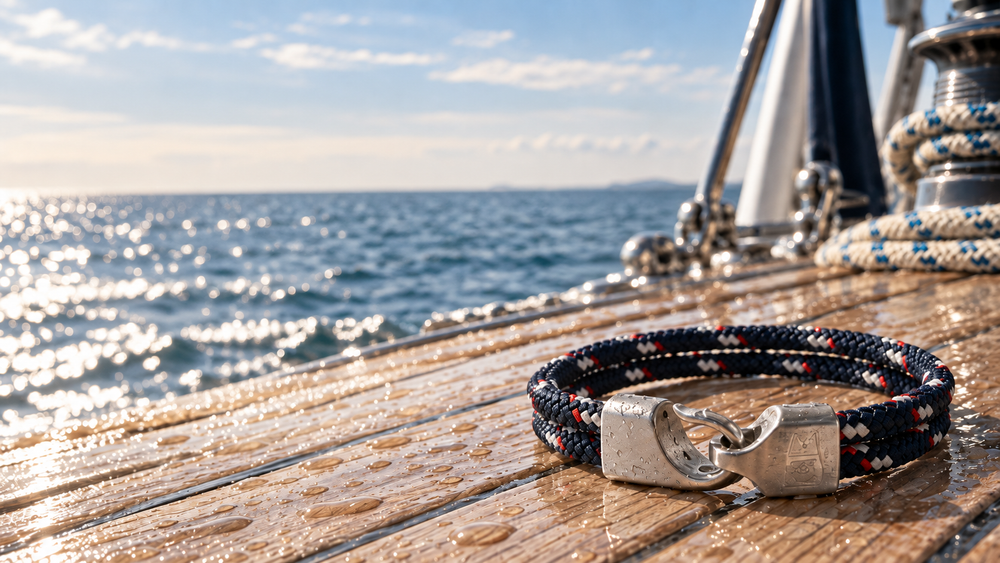
Materials · Seamanship · 2 min read
What “Marine-Grade” Should Actually Mean
The sea has a way of exposing shortcuts. Here’s what we mean when we say marine-grade, from 316L stainless steel to the line and the way it’s built.
READ THE STORY →